Additive Manufacturing Enables Cost-Efficient Production of Complex Medical Components
Additive manufacturing opens new opportunities to optimize both product design and manufacturing costs for medical equipment components. Highly complex, customized geometries can be realized using industrial 3D printing.
Many medical devices and laboratory equipment components are high-value, complex niche products manufactured in small batch sizes. Conventional manufacturing often requires expensive tooling, and these costs must be allocated across the final product price.
Additive manufacturing, by contrast, is tool-free and enables cost-efficient production of components in small batches — down to batch size one.
“The mindset must shift between turning, milling, drilling, and additive manufacturing.”
Dieter Sorg, Head of CAM, Hettich AG
Production is based on CAD data of the components. This technology enables greater design freedom and allows functions to be integrated directly into the part. As a result, manufacturers benefit from shorter time-to-market and expanded opportunities for product optimization.
From 32 to 3 Assembly Components — The Hettich Washing Rotor
Centrifuge manufacturer Hettich AG, headquartered in Bäch, Switzerland, has been developing and distributing laboratory equipment since 1977. Hettich invented and patented a new centrifuge design that enables sedimentation and separation of blood components within a single device.
For manufacturing, Hettich consistently leverages the advantages of industrial 3D printing and has significantly improved the cost-efficiency of its serial production.
Hettich purchased its first 3D printer more than 25 years ago — initially driven by technological curiosity. At that time, no production parts were additively manufactured. Today, the situation is very different: additive manufacturing offers diverse and innovative opportunities in medical technology. Components can now be designed and produced that are impossible to manufacture using conventional processes. At the same time, automation levels increase through additive manufacturing technologies.
“With additively manufactured parts, you must think in functions, not in manufacturing steps.”
Dieter Sorg, Head of CAM, Hettich AG
High-Performance Requirements in Centrifuge Applications
The Hettich ROTOMAT consists of a drum motor with six containers and collection trays. These containers feature highly complex geometries and operate at extremely high rotational speeds, reaching acceleration forces up to 1,200 times Earth’s gravity.
Typical centrifuge applications include separating mixtures into their individual components, such as preparing blood samples or creating blood count analyses.
Traditionally, a washing rotor consists of 32 individual components that must be assembled. This requires complex tooling and time-intensive assembly processes. In addition, stainless steel injection tubes require extensive deburring.
Proven Benefits of Additive Manufacturing
Transitioning to additive manufacturing has delivered measurable performance improvements for Hettich:
-
The washing rotor was redesigned and now consists of only 3 instead of 32 assembly components — with improved functionality
-
Tool-free production of containers reduces manufacturing costs
-
Small batch production and regional product variations can be implemented easily
-
Assembly requires no tools, and time-consuming deburring is eliminated entirely
3D Printing in Medical Technology Production
For manufacturing laboratory equipment, Hettich relies on EOS, a global technology leader in industrial 3D printing for metals and polymers.
EOS provides more than materials and hardware. With deep market understanding and detailed knowledge of regulatory and development processes in the medical sector, EOS collaborates closely with a strong partner network throughout the entire development and production lifecycle.
Additive Manufacturing for X-Ray Technology Components
Additional medical equipment components — for example in X-ray systems — can also be optimally produced using additive manufacturing.
Manufacturing anti-scatter grids for X-ray imaging is extremely demanding, time-consuming, and cost-intensive using conventional methods. Today, these components can be produced using optimized additive manufacturing processes.
Anti-scatter grids capture X-rays deflected by patient tissue before they reach the detector or imaging plate. This improves both contrast and diagnostic accuracy in X-ray imaging.
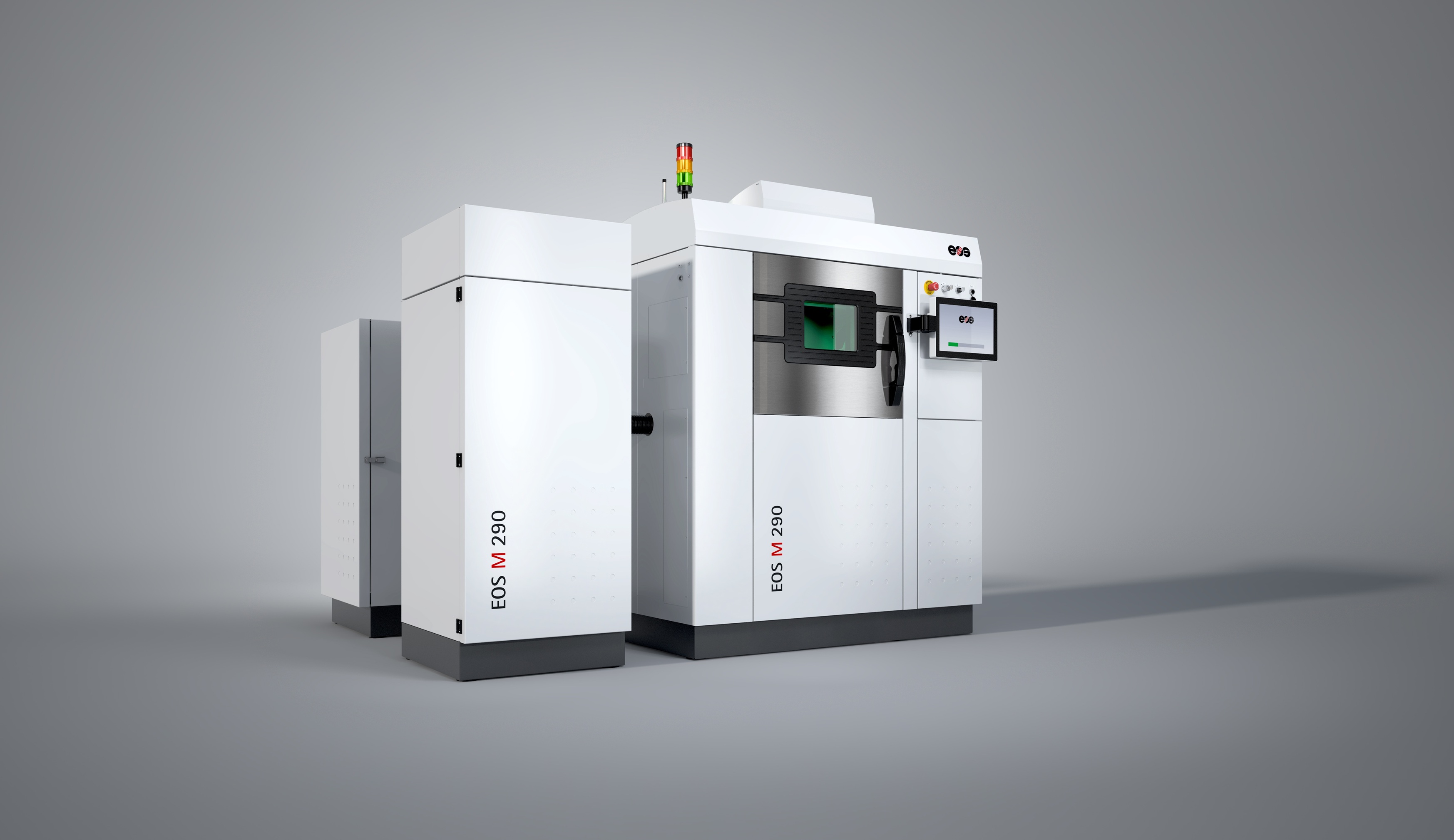
The EOS M 290 system combined with tungsten material (EOS Tungsten W1) is currently the first and only market-available solution for manufacturing high-performance anti-scatter grids.
A key advantage: significantly more attractive cost-per-part ratios compared to conventional manufacturing processes.
Switzerland as a Global Leader in Medical Technology
Switzerland has developed into a major global hub for medical technology. It is a highly attractive location for research, development, and production, supported by world-class research institutions and an excellent healthcare system that drives demand for high-performance products and innovation.
As a compact country, Switzerland enables close collaboration across the entire value chain. This allows companies to develop, produce, and commercialize new products and services in one ecosystem.
The dense R&D network — based on collaboration between leading universities, highly specialized SMEs, and global corporations — provides employment for approximately 70,000 people in the medtech sector. More than 85 % of manufacturers and suppliers produce locally in Switzerland.