Reduce Manufacturing Costs by Up to 4x with Additive Manufacturing
URMA AG is a full-service provider in additive manufacturing and has also leveraged its proven advantages in its own production facility in Rupperswil. Compared to conventional subtractive machining, manufacturing costs were reduced by up to four times through the use of 3D printing.
3D-Printed Gripper Jaws
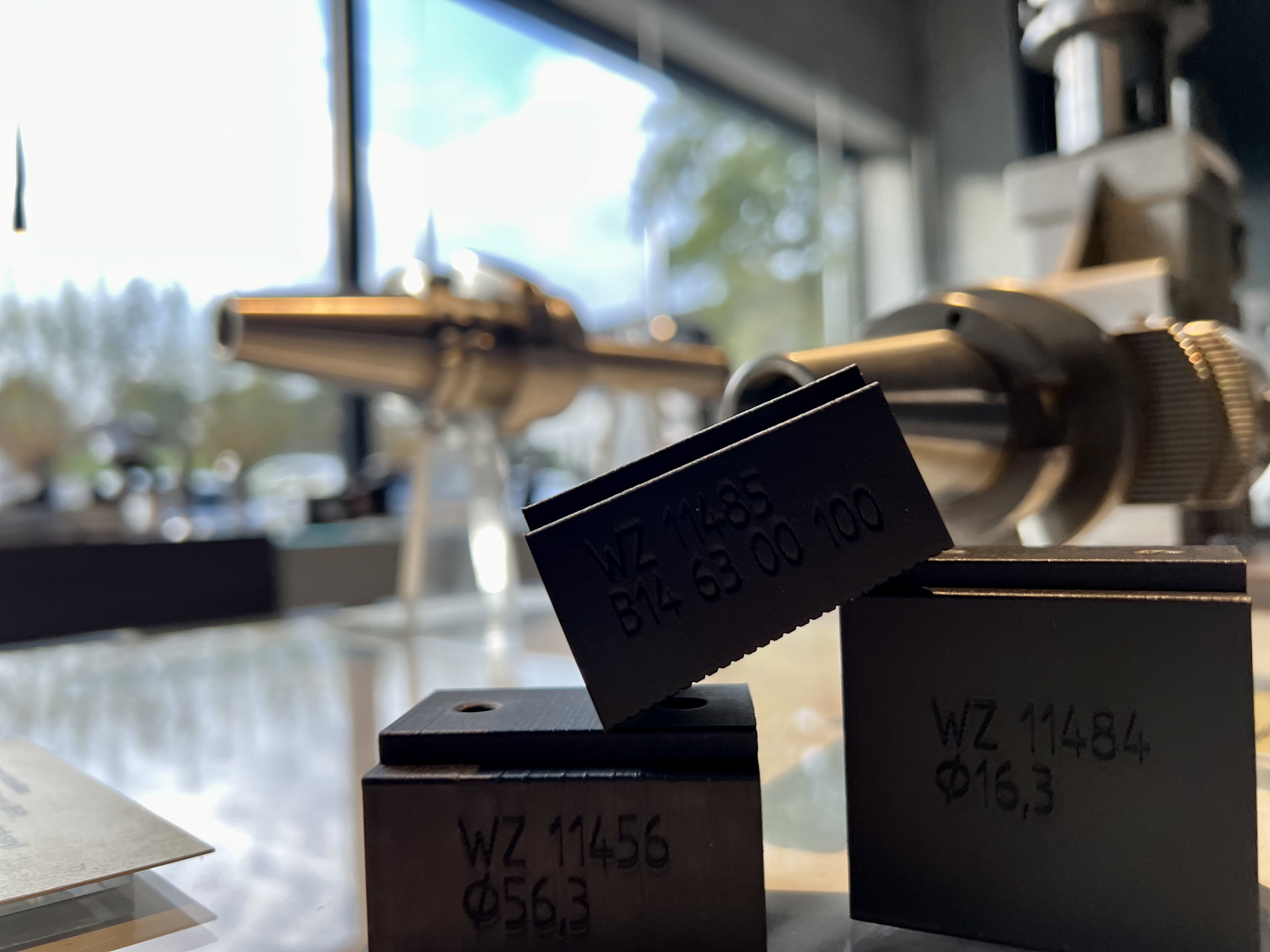
URMA’s CNC turning and milling center is equipped with an integrated workpiece unloading system realized via a spindle tool. This spindle tool requires two unloading jaws to remove finished workpieces from the chuck and transport them out of the machine.
To ensure reliable handling of different workpieces, a dedicated pair of unloading jaws is required for each diameter. Previously, 30 different pairs of unloading jaws were in use, with this number continuously increasing due to ongoing product development.
Conventional manufacturing of these unloading jaws costs CHF 385 per pair, resulting in total tooling costs of CHF 11,550.
Fast Return on Investment (ROI) Through Additive Manufacturing
Additive manufacturing not only enables cost savings but also significantly increases production flexibility. Material costs per pair of unloading jaws were reduced from CHF 30 to CHF 20.
Manufacturing cost savings are even more significant, decreasing by approximately 80% compared to machining. When considering both manufacturing and material cost reductions, overall production costs for gripper jaws can be reduced by up to four times.
For 30 pairs of unloading jaws, this results in total savings of nearly CHF 9,000.
More Flexibility and Less Material Waste with Industrial 3D Printing
Based on these advantages, URMA recognized the potential of Markforged industrial 3D printers and transitioned the production of unloading jaws from machining to additive manufacturing.
This enables faster changeovers of CNC machines to new diameters, since time-consuming machining of unloading jaws is no longer required. Only an update of the CAD model is necessary before the component can be printed without external manufacturing support.
Since setup times in additive manufacturing — especially in FFF (Fused Filament Fabrication) processes — are nearly eliminated, production of single parts or small batches becomes highly efficient. Layer-by-layer material deposition ensures material is only added where needed, significantly reducing waste.
Overnight Production of Unloading Jaws
Since the unloading jaws were previously machined in URMA’s production, a base CAD model already existed. Only a new file with adjusted diameters needed to be created.
After converting the file into a suitable additive manufacturing format (.stl), the model was prepared for printing using Markforged’s Eiger software and then sent to the Markforged printer. Only minimal 3D printing expertise is required, as the printer operates autonomously.
To maximize machine utilization, two pairs of unloading jaws (four jaws total) are printed overnight within approximately 12 hours.
The material used is Onyx, consisting of PA6 nylon reinforced with chopped carbon fiber. Kevlar fiber reinforcement is additionally integrated during the printing process. This composite material achieves mechanical strength comparable to conventional aluminum components.
Integration of Design Features and Part Identification
Another key advantage of additive manufacturing is the ability to integrate functional design features directly into the component.
This includes contouring the jaw contact surfaces to improve grip performance, as well as integrating part labeling directly into the print process — eliminating the need for separate laser engraving steps.
Machining vs. Additive Manufacturing in Industrial Production
Since adding 3D printers to its product portfolio, URMA has continuously expanded the integration of additive manufacturing into its own production environment. Over time, it has become clear that not only end-use parts, but also production tooling and fixtures offer strong potential for additive manufacturing.
Markforged composite technology has proven particularly well suited for manufacturing production tools. Due to their accessible investment cost, Markforged systems are attractive for a broad range of industrial users.
With deep expertise in industrial 3D printing and extensive application experience, URMA is convinced that additive manufacturing is a key building block for flexible, cost-efficient production.